Last updated on October 26, 2026
How to start dropshipping in 2026: key steps, legal requirements, choosing a niche and optimizing your store to convert. A complete beginner's guide.
Summary: Starting a dropshipping business takes a profitable niche, a legal business structure, an optimized store and a solid marketing plan. The global market tops $350 billion in 2025.
French e-commerce reached €196.4 billion in 2025, up 7%. In this favorable climate, starting a dropshipping business appeals to more and more entrepreneurs who want to sell online without managing inventory. But the low barrier to entry hides a tougher reality: fierce competition, thin margins and strict legal obligations.
Dropshipping is neither a shortcut to wealth nor a doomed model. It's a sales channel that, done right, lets you test products, validate a market and build a brand. Everything hinges on the quality of your store, your choice of suppliers and your ability to turn traffic into loyal customers.
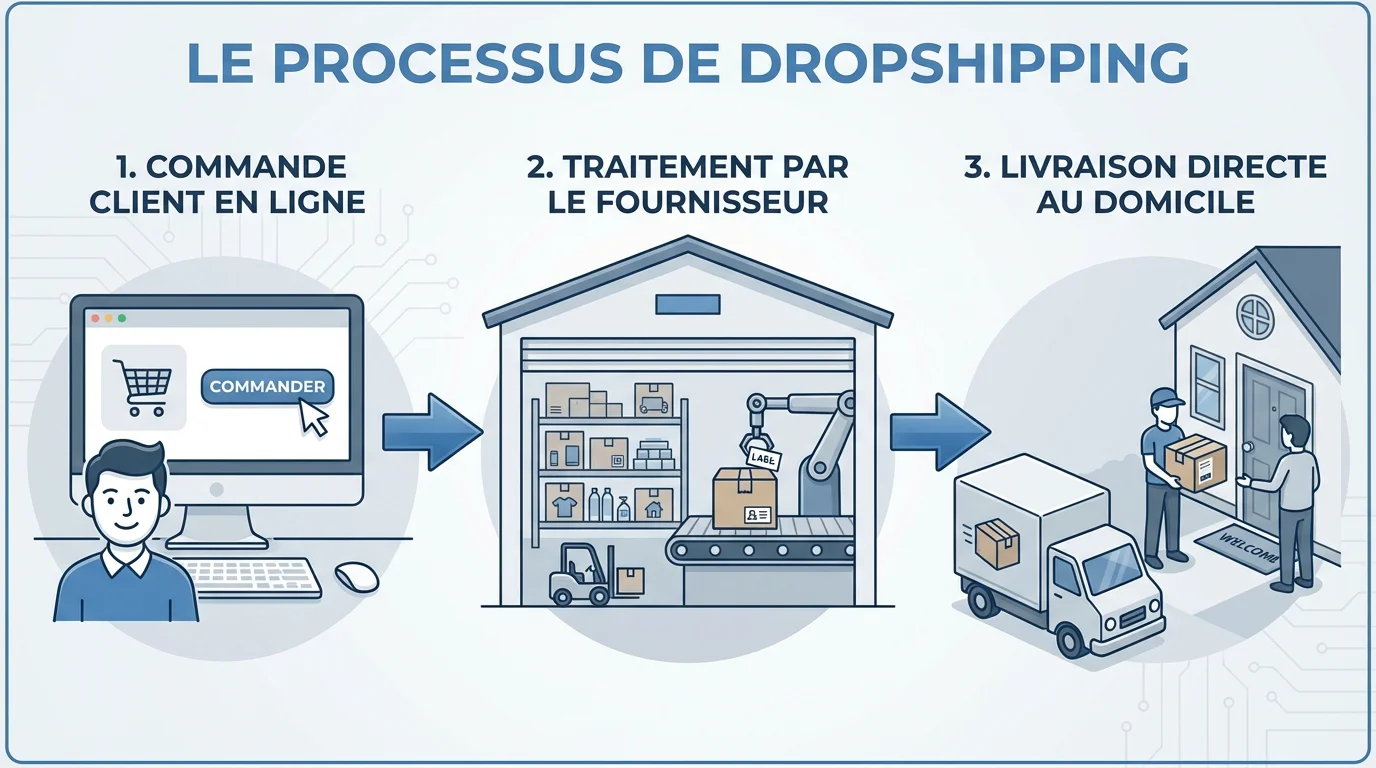
Dropshipping is a retail method where your online store doesn't stock any products. When a customer places an order, you pass it on to a third-party supplier who ships it directly to the end customer. Your role focuses on merchandising, marketing and customer service.
Three players are involved in the chain: the customer who buys on your site, you as the middleman seller, and the supplier who handles logistics. The global dropshipping market was valued at $365.67 billion in 2024 and is expected to reach $1,253.79 billion by 2030, a compound annual growth rate of 22%.
In practice, the process follows five simple steps: you pick products from a supplier, list them in your store, the customer places an order, you forward that order to the supplier (often automatically), and the supplier ships the package. About 27% of e-commerce businesses use dropshipping as their main order fulfillment model.
According to Grand View Research, the global dropshipping market is projected to exceed $1,250 billion by 2030. That growth is driven by the rise of online shopping in every region of the world and by store-building tools becoming accessible to everyone.
Europe is just as dynamic. The European dropshipping market was worth $23.8 billion in 2025 and is expected to grow 17.1% per year. France, with e-commerce revenue approaching €200 billion, offers fertile ground.
Among the major dropshipping trends: the rise of local and European suppliers (to cut delivery times), the use of artificial intelligence in order management and customer personalization, and the growth of niches tied to wellness, sustainable fashion and tech accessories. Fashion accounts for more than 34% of the market, while food and personal care is the fastest-growing segment, at 23.6% per year.
Dropshipping's main appeal is its low upfront investment. With no inventory to buy and no warehouse to rent, you can start with a limited budget spent on your store and your first ad campaigns. The model also lets you test new products quickly without major financial risk.
Location independence is another advantage. You can run your business from anywhere with an internet connection. Scalability is also a plus: expanding your catalog doesn't require any extra logistics on your end.
On the other hand, profit margins remain modest. Most dropshippers operate with a 15 to 20% net margin, while top-performing stores reach 30% and beginners often fall below 10%. Competition is intense, especially on generic products. Delivery times, sometimes long with Asian suppliers, can hurt customer satisfaction. And you remain accountable in the customer's eyes, even when the mistake is the supplier's.
It all starts with choosing a profitable dropshipping niche. Target a specific segment with steady demand and manageable competition. Analyze trends with tools like Google Trends, watch social media and study popular products on marketplaces. Favor products that solve a real problem or trigger an emotional purchase.
Do some basic market research: identify your competitors, assess their pricing and analyze their messaging. If the market is saturated, stand out through your brand positioning or find an untapped angle.
In France, registering a business is mandatory to run a dropshipping operation. Regularly selling products online can't be done as a private individual; registration with the trade and companies register is required. The micro-entreprise (France's simplified sole-proprietor status) suits beginners thanks to its lighter administration. For more ambitious projects or better protection of personal assets, a SASU or EURL (French single-member companies) may be a better fit.
Your supplier is the backbone of your business. Always order samples to check quality. Evaluate delivery times, return policies and how responsive their customer service is. European suppliers offer shorter delivery times and better compliance with CE standards, a real plus for keeping French customers satisfied.
Your store is your storefront. It has to inspire trust from the very first second. Polished design, detailed product pages with quality visuals, a smooth checkout flow: every detail counts. To save time without sacrificing performance, you can use a Shopify theme built for dropshipping with conversion features built in natively.
No traffic, no sales. Combine paid acquisition (Meta Ads, Google Ads) with organic channels (SEO, content marketing, social media). In dropshipping, marketing is often your biggest expense. To keep your budget under control, you need to calculate your cost per acquisition so you can identify your most profitable channels.
Track your key metrics: conversion rate, average order value, acquisition cost and ROAS. The average e-commerce conversion rate typically ranges from 1.5% to 3%, with large variations by industry and device. Keep testing your product pages, ads and offers. The stores that succeed are the ones that optimize relentlessly.
Attracting visitors isn't enough; you have to turn them into buyers. A commonly cited ballpark puts the average conversion rate between 2% and 5% in 2025. To reach the top of that range, a few levers are essential.
Page load speed plays a critical role: a slow site loses visitors before they even see your products. The mobile experience has to be flawless, since most traffic now comes from smartphones. Trust signals (customer reviews, a clear return policy, secure payment) reduce friction at checkout.
To go further, work on optimizing your conversion rate on Shopify by methodically improving every step of the customer journey. A/B tests on your product pages, call-to-action buttons and promotional offers, run with third-party testing tools, deliver meaningful gains that add up over time.

One point many beginners overlook: the legal framework. With dropshipping, you're subject to distance-selling regulations. As the seller, you're liable for any quality or delivery defect, even if your supplier handles shipping. The DGCCRF (France's consumer protection authority) actively monitors this sector.
Your legal obligations include: displaying complete legal notices and terms and conditions of sale, honoring the 14-day right of withdrawal, being transparent about tax-inclusive prices and delivery times, ensuring products comply with European standards, and filing VAT according to current rules. Misleading commercial practices are punishable by up to 2 years in prison and a €300,000 fine.
To operate with peace of mind, check the DGCCRF's practical guide to dropshipping. It details exactly which pre-contractual information you must give your customers and the penalties for non-compliance.
How much do you need to get started in dropshipping? While the model limits upfront investment (no inventory), you still need a realistic budget. Plan for €500 to €2,000 for the first few months, split between your e-commerce platform subscription, a professional theme, your first ad campaigns and possibly a domain name.
The real challenge is profitability. For every $10,000 in revenue, successful dropshippers typically make $1,500 to $2,000 in actual profit. To keep an eye on your financial performance, it helps to measure your return on ad spend (ROAS) so you never spend more than each campaign brings in.
Profitability comes down to three levers: increasing average order value (cross-selling, bundles), lowering customer acquisition cost (optimizing ads and SEO) and retaining existing buyers (emails, personalized offers). Only 10% of dropshippers succeed in their first year, a reminder of how much persistence and continuous optimization matter.
Trying to sell “everything to everyone” is the most common mistake. General stores with no brand identity struggle to stand out. General stores selling random gadgets are in decline; niche stores with clear branding and reliable suppliers are taking their place.
Neglecting customer service is another major mistake. In dropshipping, you're the buyer's only point of contact. Responding quickly, handling returns transparently and anticipating delivery issues are must-haves. Underestimating your ad budget is also common: without an initial marketing investment, your store will stay invisible.
Finally, copying your suppliers' product descriptions hurts both your SEO and your credibility. Write original descriptions, use authentic visuals and build a consistent brand universe. That's what turns a basic dropshipping site into a store people trust.
Starting a dropshipping business is still a solid opportunity in 2026, as long as you approach it as a real entrepreneurial project. The global market tops $350 billion, online demand keeps growing and the available tools have never been more accessible. What makes the difference is rigorous execution: a well-chosen niche, reliable suppliers, strict compliance with the legal framework and, above all, a store built to convert. The FullStack theme, an all-in-one Shopify theme designed by CRO experts, packs 100+ native features with no third-party apps required, so your store is up and running in minutes. Ready to take action? Explore our plans to launch your store and try it free for 14 days.
A realistic starting budget is between €500 and €2,000. It covers an e-commerce platform subscription, a professional theme and your first ad campaigns. Dropshipping saves you from buying inventory, but marketing remains an unavoidable expense.
Yes, dropshipping is perfectly legal as long as you meet online commerce obligations: registration with the RCS (trade and companies register), legal notices, compliant terms and conditions of sale, a 14-day right of withdrawal and VAT filing. The DGCCRF can penalize violations.
Work on page load speed, the mobile experience, product page quality and trust signals. Regular A/B testing is essential. The FullStack theme natively includes 35 sections, 44 public blocks and 100+ native features to help you convert more visitors without piling up apps.
Rated 4.9/5 out of 200+ reviews






